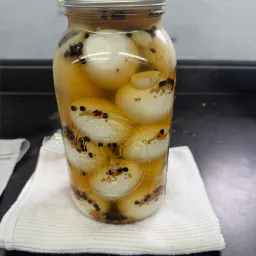
A no-beet, no-sugar, straight-vinegar pickled egg in the German-American saloon lineage — sharp, plain, and unapologetically hard-edged.
For where this recipe comes from and why it has no sugar or beets in it, read No Beets, No Sugar, No Bullshit: The Real American Tavern Pickled Egg.
Ingredients
Eggs & Brine
- 12–18 eggs, hard-boiled and peeled
- 4 cups distilled white vinegar (5% acidity)
- Optionally substitute 1 cup distilled white vinegar with apple cider vinegar (5% acidity) — see Variation 1
- 2 tbsp kosher or pickling salt — not iodized table salt, see notes
- 2 tbsp whole yellow mustard seed
- 1 tbsp whole black peppercorns (I usually dump more in)
- 2-3 bay leaves
- 4-6 garlic cloves, smashed
- 1 small yellow or white onion, sliced into rings (optional — see notes)
- Optionally add some heat with 1 tsp crushed red pepper flakes, or 3 small dried whole red chiles, or a few dried red chiles or fresh jalepenos — use whichever you have on hand
Directions
- Boil and peel the eggs. Hard-boil the eggs. You are welcome to use my Boiled Eggs method, which usually helps with an easier peel.
- Build the brine. In a non-reactive saucepan, combine the vinegar(s), salt, mustard seed, peppercorns, bay leaves, garlic, and your chosen heat source.
- Bring to a boil. Boil, stirring to dissolve the salt, then simmer 2–5 minutes to bloom the spices.
- Cool or pour — pick your method (see Variation 2 below):
- Cooled-brine method: Remove from heat and let the brine cool completely to room temperature before pouring over the eggs. This keeps the whites tender.
- Hot-brine method: Pour the brine, spices and all, hot and directly over the peeled eggs. I like them this way. A little rubbery.
- Pack the jar. Layer the peeled eggs with the onion rings (if using) in a clean quart or half-gallon glass jar — not packed so tight that brine can’t circulate. Pour the brine over until the eggs are fully submerged. Don’t be afraid to pack them tight.
- Cool and seal. If you used the hot-brine method, let the jar cool uncovered to room temperature before sealing. Seal and refrigerate.
- Cure. Refrigerate at least 3 weeks before eating. This is the hardest part. A full 3 weeks gives the brine time to work past the white and into the yolk, and gives the classic saloon-jar bite.
- Storage. Keep refrigerated. Whites will progressively firm and toughen with time — that’s part of the tradition, not a flaw.
Serve at room temperature or straight from the jar, with pretzels and a cold beer.
Notes
Variations & Substitution
- Vinegar blend: Use all white vinegar for the sharpest, most classic saloon flavor, or swap in 1 cup of apple cider vinegar for a slightly rounder, fruitier tang.
- Cooled brine vs. hot brine: Cooling the brine completely before pouring it over the eggs keeps the whites from toughening. Hot brine results in firmer, more cured whites as part of the tradition. Choose the cooled method if you prefer tender whites, or the hot method if you want a faster infusion and don’t mind a firmer bite.
- Heat level: Use crushed red pepper flakes or dried whole chiles mixed into the brine for even heat throughout. For more fire, add fresh sliced jalapeños or dried chiles de árbol alongside the red pepper flakes.
- Storage life: Estimates ranged from 2 months up to 3–4 months refrigerated. To be safe, plan on eating within 2 months and always keep the eggs fully submerged in brine.
Salt
- Use kosher or pickling salt. Do not use iodized table salt. It won’t hurt you, but it will visibly and audibly cheapen the jar, and in a brine this plain there is nothing to hide behind.
- The iodine is the first problem. Iodized salt carries potassium iodide plus a stabilizer (usually dextrose, a trace of sugar) to keep the iodine from breaking down. In a long acidic cure that iodine can pick up a faint metallic, bitter edge and darken both the whites and the brine. It’s the reason canning guides have told people to leave it out for decades.
- The anti-caking agents are the second. Table salt is cut with sodium ferrocyanide, calcium silicate, or sodium aluminosilicate to keep it pouring freely. None of them dissolve. They turn a clear brine cloudy and leave a fine grey sediment on the bottom of the jar and on the eggs — which looks exactly like the early stage of a jar going bad, so you end up throwing out perfectly good eggs.
- Kosher salt and pickling salt are essentially pure sodium chloride with neither additive. Plain sea salt works too, as long as the label doesn’t list an anti-caking agent.
- If you swap salts, weigh instead of measuring by volume. Grain size changes what fits in a tablespoon: 2 tbsp is roughly 30 g of Morton kosher, about 19 g of Diamond Crystal, and about 36 g of fine table salt. Same spoon, nearly double the salt.
Garlic
- Your garlic may turn blue or green. This is normal, and the eggs are fine. Somewhere in the first days or weeks of curing, the smashed cloves can go anywhere from faint blue-green to an alarming teal. Nothing has spoiled, nothing has gone off, and it does not mean you used the wrong jar or the wrong vinegar.
- Why it happens: garlic contains sulfur compounds (chiefly isoalliin) that are released when you crush or slice the cloves. In an acidic environment like a straight-vinegar brine, those compounds break down into pyrrole rings, which link up with each other and with amino acids in the garlic to form blue and green pigments — the same chemistry that turns garlic blue in pickled cucumbers or in Chinese Laba garlic, which is deliberately made this color for the Lunar New Year.
- What makes it more likely: cold-stored, older, or immature garlic (higher in isoalliin), a cold brine, and a long cure — which is to say, exactly the conditions in this recipe. Trace copper from tap water or a copper pot can deepen the color, but it is not the cause and its absence will not prevent it.
- The pigment is harmless and essentially flavorless. Eat the garlic or leave it in the jar, whichever you like. If the color still bothers you, use fresh, fully mature garlic, or bring the brine to a boil with the garlic in it before jarring — heat knocks out the enzyme that starts the reaction.
- Real spoilage looks nothing like this: cloudy, ropey, or slimy brine, a fizzing or bulging jar, fuzz on the surface, or a smell that is rotten rather than sharp. That jar goes in the trash. Blue garlic in clear brine does not.