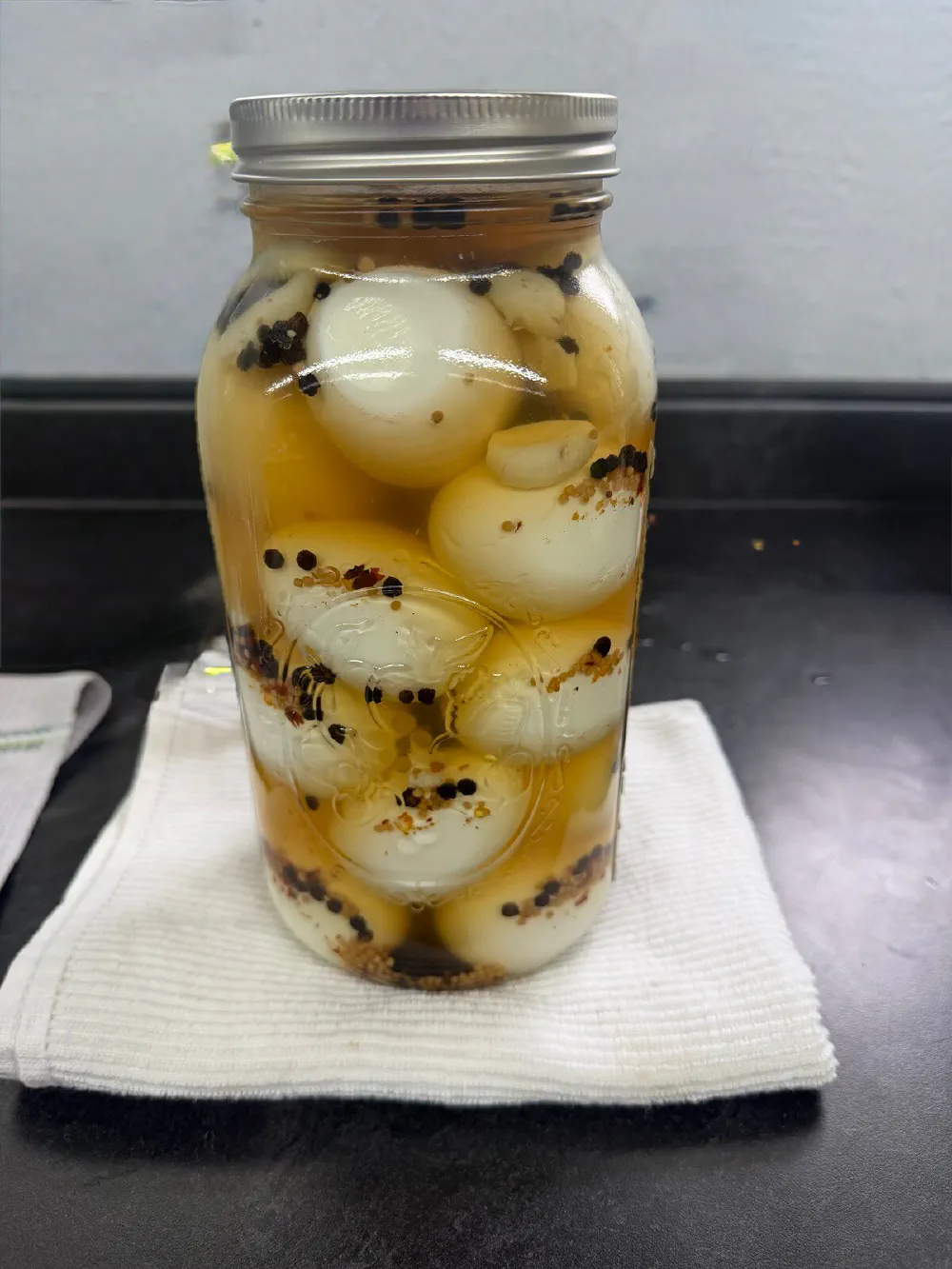
No Beets, No Sugar, No Bullshit: The Real American Tavern Pickled Egg
Luke Taylor
Where the tavern pickled egg actually comes from
The working recipe that came out of this research is here: Tavern-Style Pickled Eggs.
I got tired of looking up pickled egg recipes and finding the same pink, sugar-bomb, beet-juice mess every single time. That’s not a bar egg. That’s a craft fair. If you’ve ever actually eaten one out of a gallon jar sitting on a bar counter next to the pretzels, you know it’s supposed to hit you like a fist — hard vinegar, no sweetness, no color, just an egg that’s been sitting in something angry for three weeks.
So I dug into where this thing actually comes from, and I’m not putting a single claim in here I can’t point you to. If I couldn’t find a real source for something, I’m telling you flat out instead of making it up like every food blog on the internet does.
Where this actually comes from
This isn’t a British pub thing. Malt vinegar, sweet brines, that’s a different lineage. This is a German-American saloon thing, and the timeline checks out.
German immigration reshaped American drinking culture in the mid-1800s, and the hard-boiled egg became a fixture of the saloon “free lunch” — food put out cheap or free specifically to keep guys ordering another beer. That’s not folklore, it’s documented by drink historian Christine Sismondo, author of America Walks Into a Bar — see the Tales of the Cocktail Foundation’s history of the bar egg.
Another source puts it more directly: German saloon owners introduced pickled eggs alongside lagers to working-class America in the mid-1880s — Dive Bar NYC’s history of the pickled egg. Same piece floats a 17th-century French bar-egg origin theory. I’m not repeating that as fact — the article itself hedges it as “most likely,” with nothing behind it, so it stays out of the history and out of my recipe.
Wisconsin is the clearest American epicenter of this, and it’s not vibes — it’s newspaper record. A Sheboygan County local-history piece cites 1868 and 1873 clippings from the Sheboygan County Herald documenting the German-settled town of Hingham shipping barreled pickled eggs a hundred thousand dozens at a time, enough to earn the “Egg Capital of Wisconsin” nickname. That same piece claims pickled eggs were common in German households as early as the mid-1700s, tied to Hessian mercenaries during the Revolutionary War — that specific claim isn’t backed by a primary source in the article, so treat it as local tradition, not settled fact. Read the Sheboygan pickled-egg history here.
PBS Wisconsin’s documentary Bottoms Up backs the mechanism independently: Wisconsin’s whole tavern culture grew out of German-immigrant beer-drinking settlement. Watch/read about it here.
Joe Jost’s in Long Beach, opened in 1924, is a living continuation of the same format — pickled egg, brine, pretzel, cold beer, all in one bar. OC Weekly’s writeup, with the actual house recipe. Their original recipe includes sugar and turmeric for color. I cut both. That’s my call, not a historical claim.
Why no beets, and why no sugar
The pink, sweet, beet-brined egg is real, but it’s a branch, not the trunk. Wikipedia’s entry on pickled eggs is specific about this: the beet version is historically tied to the Pennsylvania Dutch, with sugar, cinnamon, and beets in the brine specifically to get that color and sweetness. Source. That’s a regional variant of the German-American pickling tradition — not the bar-counter default, and definitely not what a Wisconsin tavern jar looked like.
As for why it should taste sharp instead of balanced — I couldn’t find an actual historian who documented that decision. What I can point to is the people still doing this the old way: a home-brewing forum thread reproduces Joe Jost’s recipe and cuts the sugar entirely, saying flat out it’s not needed — Homebrew Talk thread. A backyard-chicken-keeping forum thread on favorite pickled egg recipes pushes the same direction — undiluted vinegar, no watering it down — BackyardChickens thread. That’s not historical proof. That’s just what people who still make these by hand keep landing on, which tells you something.
One more thing to mention. I kept coming across recipes using “pickling spice”. That’s wrong for this era. The jarred, named commercial blend is an early-1900s product — it postdates the mid-1800s saloon lineage this recipe is claiming by decades. A saloon keep in that period reached for individual spices out of the pantry, not a pre-mixed jar. So the recipe lists everything individually.
The recipe
It lives on its own page, where I keep it up to date: Tavern-Style Pickled Eggs — mustard seed, peppercorns, bay, salt, garlic, onion, and straight white vinegar, with the hot-brine option, heat levels, storage notes, and the reason your garlic may turn blue. For the eggs themselves, here’s how I boil them.
No sugar. No beets, beet juice, or red coloring, ever. Four spices, no pink, no nonsense. Sharp enough to make you want another beer, which was the whole point in the first place.