Servings
2 ServingsPrep time
10 MinutesCooking Time
35 MinutesCalories
--- KcalThe excuse to eat a bowl of garlic butter
An artichoke is mostly a delivery system for whatever you dip it in, and nobody has improved on melted butter with garlic in it. The eating is slow and hands-on — pull a leaf, scrape the meaty base against your bottom teeth, discard the rest — which makes this a good thing to put in front of people who are standing around your kitchen waiting for dinner. The heart at the bottom is the payoff.
Ingredients
Artichokes
- 2 large globe artichokes
- 1 lemon, halved
- Salt
Garlic Butter
- 1 stick (1/2 cup) unsalted butter
- 3–4 cloves garlic, minced or grated
- 1 tablespoon lemon juice, or more to taste 1
- Salt
Directions
- Cut off the top inch of each artichoke with a serrated knife, so the tight inner leaves are opened up.
- Snip the thorny tip off each of the outer leaves with kitchen shears. This is optional but makes them much friendlier to handle at the table.
- Trim the stem flush with the base so the artichoke can sit upright, or peel the stem and leave two inches on — it is the same tissue as the heart and tastes the same. 2
- (Optional) Rub every cut surface with a lemon half as you go, and drop the trimmed artichokes into a bowl of cold water with the squeezed lemon halves in it. 3
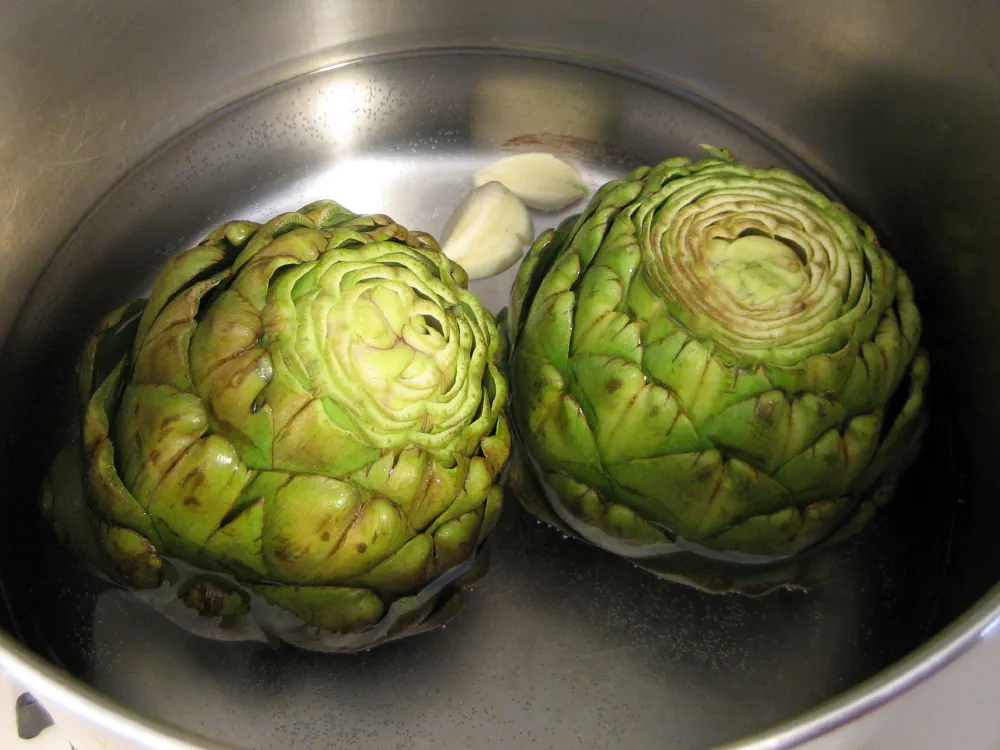
- Set a steamer basket in a large nonreactive pot over an inch or two of salted water. 4
- Stand the artichokes in the basket stem-end up, cover, and bring to a boil, then reduce to a steady simmer.
- Steam for 25 to 45 minutes depending on size. They are done when an outer leaf pulls away with no resistance and a paring knife slides into the base of the stem easily.
- While they steam, melt the butter over low heat with the garlic. Keep it gentle — you want the garlic softened and fragrant, not browned, which takes about 5 minutes.
- Off the heat, stir in the lemon juice and salt to taste. Pour into two small bowls.
- Drain the artichokes upside down for a minute so the water trapped between the leaves runs out, then serve warm with the butter.
Eating One
- Pull off a leaf, dip the pale base in butter, and draw it through your teeth to scrape off the flesh. Discard the leaf.
- Work your way in. The leaves get more tender and more edible as you go.
- When you reach the thin, papery inner cone, pull the whole cone out at once.
- Underneath is the choke — a dense tuft of fine fibers. Scrape it out with a spoon and throw it away. It is not edible and it does not soften with cooking.
- What remains is the heart. Trim off any stem end that is still tough, cut it into pieces, and finish the butter with it.
Notes
- Buy artichokes that feel heavy and squeak when you squeeze them. Leaves that have spread wide open or gone brown and dry at the edges mean it has been sitting a while.
- Steaming beats boiling here only because a boiled artichoke holds a surprising amount of water in it. If you have no steamer basket, boil them and just drain them well.
- Leftover garlic butter is worth keeping. It sets up solid in the fridge and is good on bread or tossed with pasta.
- Cold leftover artichoke is fine eaten as-is, and the hearts are good chopped into Bruschetta.
Footnotes
-
Add the lemon juice after the butter comes off the heat. Acid in hot butter is fine, but the flavor is brighter if it has not been sitting over a burner. ↩︎
-
The stem is only bitter at the outer layer. Peel that off with a vegetable peeler and the core inside is an extension of the heart. ↩︎
-
Cut artichoke turns brown fast — the same enzymatic browning as a cut apple — and the acid in lemon juice slows it down. It is cosmetic, not a matter of flavor or safety, so skip it if you are going straight into the pot. ↩︎
-
Bare cast iron and uncoated aluminum will turn artichokes a dull gray. Stainless or enameled is what you want. ↩︎