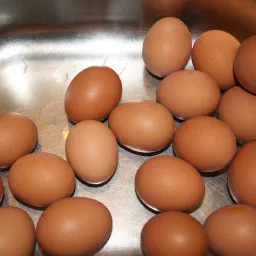
Boiling eggs that come easily out of the shell is a fairly straightforward process. Sometimes the eggs have a mind of their own and no matter what you do, they just won’t peel easily. This process works most of the time with the best results of any other process I have used, with a minimum of fuss.
Ingredients
Ingredient Subheading
- Eggs, straight from the refrigerator 1
- Salt
- Tap water
Directions
- Fill a pot or a large flat-bottom pan with enough water that the eggs — once added — will be submerged or nearly submerged.
- Add salt to the water. 2
- Cover with a lid.
- Turn the burner to high and bring the water to a full boil.
- Once boiling, take the eggs straight from the refrigerator and, using a slotted spoon, gently lower them into the boiling water. Cover again.
- Once the water returns to a boil, set a 12 minute timer and reduce the heat to medium-high.
- When the timer goes off, carefully run cool tap water over the eggs for 2–3 minutes.
- Do not dry the eggs. Set the warm, wet eggs on a dish towel and let them cool for 10 minutes or more before peeling.
Notes
- Completely covering the eggs with water is not necessary as long as the pot or pan is covered with a lid — the trapped steam cooks whatever is above the waterline.
- Lowering cold eggs into already boiling water is the part that matters most for peeling. The outer layer of white sets fast against the shell membrane instead of slowly gluing itself to it, which is why this method peels more reliably than a cold-water start.
- Fresher eggs are always the harder peel. If you have a choice, use the older carton for boiling and save the fresh ones for frying.
- Adjust the timer to taste: about 7 minutes for a jammy yolk, 9–10 for barely set, 12 for a fully firm yolk with no green ring.
- These are the eggs I use for Tavern-Style Pickled Eggs.
Footnotes
-
Refrigerated eggs are used deliberately here. Cold eggs going into boiling water give the sharp temperature difference this method relies on, and the 12 minute timing assumes they start cold. ↩︎
-
Salt does raise the boiling point of water, though at normal seasoning levels the effect is a fraction of a degree — plain water boils at 212 °F, and a heavily salted pot maybe a degree above that. The more practical benefit is that if a shell cracks, the salty water helps the escaping white coagulate quickly and seal the crack instead of streaming out into the pot. ↩︎